U.S. Military Recovery Operation on Vatnajökull
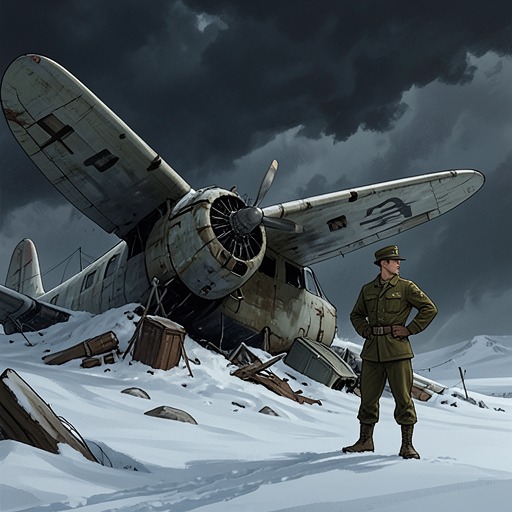
Operation NapoleonThe U.S. Military Recovery Operation on Vatnajökull is a covert effort to excavate a German Junkers aircraft from the glacier, dismantle it, and remove its wreckage before outsiders can interfere. The operation’s controlled machinery—satellite surveillance, armed guards, cutting equipment, and helicopters—turns a remote crash site into a military work camp, while the bodies preserved in the ice make clear that the salvage is also an encounter with a sealed and unresolved past.
Surveillance and the start of the recovery
In Washington, D.C., Vytautas Carr enters a dim control room where satellite operators monitor images of Iceland. The view shifts from the outline of the island to the southern Vatnajökull, then tightens until the glacier’s crevasses and the workers around the plane become visible. Carr sees the aircraft protruding from the ice, with men digging beside it and blowtorches beginning to cut through its fuselage. The distant, grainy image places the operation under observation even as its workers rely on winter darkness and isolation to conceal their activity.
On the glacier, Ratoff oversees a carefully organized dismantling. At around minus fifteen degrees Celsius, some men break the hard surface with pickaxes while others use oxyacetylene torches to divide the plane into sections. The plan is to load those sections onto pallets and tow them to trucks bound for Keflavík Airport. A storm is forecast, but Ratoff expects it to pass quickly; the job appears to be on schedule. The choice of winter is double-edged: conditions can make travel difficult, but darkness and the lack of traffic also shield the operation.
That orderly progress changes when workers uncover a leg beside the fuselage. Ratoff orders them to expose the remains: a corpse in a high-ranking German officer’s uniform, with an Iron Cross at its throat, hands crossed over its chest, and a cap frozen over its face. One leg is missing, torn away at the hip. Its position suggests to Ratoff that someone who survived the crash may have moved and arranged the dead. He orders the body freed from the ice and taken to a tent, recognizing that the passengers who lived through impact would have faced the cold without the Arctic gear, lamps, or training available to his own men.
The aircraft itself resists the salvage plan. As the front section is being cut, it bends and breaks under its own weight, collapsing onto the ice with a screech and crash while the tail remains partly buried. Ratoff orders the severed section prepared for removal and forbids anyone to enter the plane without his permission. Only then does he climb into the cabin, where the noise outside gives way to the stillness of a space undisturbed for more than half a century. The first discovery inside makes the wreck more than a difficult object to extract: among the frozen passengers are a German officer and a two-star American general, whose locked aluminum briefcase is handcuffed to his wrist.
The bodies and the missing passenger
Ratoff searched the tail section, still largely trapped in the ice, and found three more bodies huddled together at the rear of the cabin. Their grouping suggested an effort to share warmth during the passengers’ final hours. The cold had left exposed skin bluish-white and firm, without visible decomposition; crude splints had been made for the legs of two of the dead. One wore an American uniform, including a leather bomber jacket issued to U.S. fighter pilots during the Second World War, a small American flag on the sleeve, and a name embroidered on black linen. He appeared to be no more than twenty-five. Ratoff counted six bodies in all, including the officer found outside the plane, although his briefing had led him to expect seven.
The American pilot’s presence deepened the mystery rather than resolving it. The aircraft was a German Junkers painted in U.S. camouflage, yet its pilot appeared to be an American fighter aviator. Ratoff also found that the aircraft seemed to have been flown single-handedly: the cockpit had seats for a co-pilot and navigator, but the bodies elsewhere aboard did not appear to account for either role. These physical details—uniform, flag, name, and the empty crew positions—made the wreck’s contents difficult to reconcile with an ordinary German transport flight.
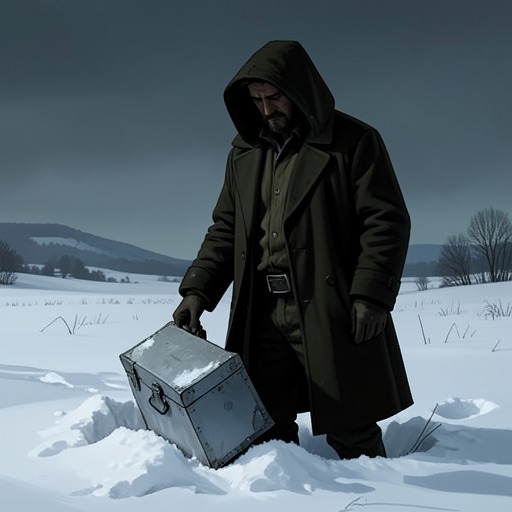
The expected treasure trove was absent. Ratoff found no more boxes, and the handcuffed aluminum briefcase was the only personal object of significance he discovered. Carr had ordered him to remove every document from the plane, so Ratoff forced the briefcase’s lock with a scrap of metal; its contents initially looked like worthless files and papers. A search of the bodies yielded only ordinary wallets and passports. The German-uniformed men ranged from forty to sixty; one seemed to have held the rank of general and wore unfamiliar medals as well as an Iron Cross at his throat.
Before leaving the cockpit, Ratoff collected the pilot’s flight chart and logbook. He also noticed a small red exercise book protruding from beneath the co-pilot’s seat and pocketed it. The salvage thus produced a set of records whose importance was not yet apparent, alongside a stark discrepancy in the number of passengers: six bodies recovered, but seven expected. Ratoff ordered the remains removed from the aircraft and placed in body bags, while the operation continued to treat the wreck as cargo to be extracted.
The airlift and the approaching rescuers
As the recovery moved from excavation toward removal, Ratoff prepared to lift the aircraft in two sections. Men cleared snow from one side of the Junkers and fixed slings around its front half; the plan was to put the bodies back inside, seal the opening, and carry the wreckage away in a single operation. Helicopters would make the secrecy of the mission harder to maintain, so the men intended to cover the aircraft with tarpaulins. Ratoff was not troubled by the prospect of rumours: in his view, more rumours could serve the operation as well as concealment.
The communications officer reported movement on the radar. The Reykjavík Air-Ground Rescue Team was advancing toward the glacier, and Ratoff had already sent soldiers to intercept it, hoping to stop or delay its approach. At the same time, two other figures were moving in from the south. Ratoff suspected they might be the young woman from Reykjavík, Elías’s sister, who had already outwitted Bateman and Ripley and put one of them in hospital. A reception party was sent to meet the pair at the edge of the ice, while the troops dispatched toward the rescue team came to a halt.
Two Pave Hawk helicopters arrived from the west in darkness. Ratoff’s men had marked a landing site with two rings of torches and fired four flares, which hung above the glacier and cast an orange-yellow light over the camp. The helicopters settled onto the ice amid swirling snow; their crews were directed to Ratoff’s tent. The arriving pilots found a floodlit encampment of tents arranged around the half-buried aircraft. Its swastika remained visible beneath the cockpit, while peeling camouflage exposed the grey metal below. Plastic sheeting covered the open cabin, and the pilots had been given no explanation for their nighttime summons: they were to airlift heavy equipment to a C-17 waiting at Keflavík Airport and ask no questions.
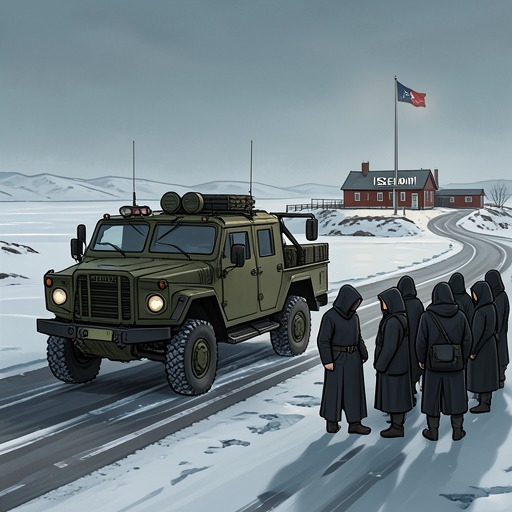
At 0015 GMT on Sunday, 31 January, Kristín and Steve were brought into the camp on snowmobiles, riding behind their captors while the vehicles maintained radio contact with the base. From a ridge they saw the tents and equipment spread across the ice: helicopters, snowmobiles, tracked vehicles, generators, floodlights, satellite dishes, and scores of personnel. Some tents were already coming down. The camp’s activity had shifted from excavation to departure, and Kristín understood that the soldiers meant to leave no trace; soon, snowfall would erase their tracks.
Only then did Kristín see the aircraft itself, cut in half in a shallow depression, with teams fastening thick slings to both sections and cables running toward the helicopters. The wreck was about to be removed from the glacier. In a tent, while the guards’ attention was drawn outside, she and Steve noticed the corner of a grey body bag under a tarpaulin. Kristín shifted the canvas with her foot until the bag’s open zipper exposed a peaked cap bearing an eagle and swastika, then the pale face of a middle-aged man. The recovery had treated the dead as part of the load to be moved; for Kristín, the exposed body became a new discovery inside the operation’s hurried effort to clear the ice.
The parallel rescue
Thirty-five miles from the wreck, the recovery operation’s advance unfolded alongside a desperate search for Elías and Jóhann. Eight members of the Reykjavík Air-Ground Rescue Team followed snowmobile tracks west toward a belt of crevasses; back at their base, they had pinpointed the signal of Elías’s mobile phone. The trail suggested that the snowmobiles had plunged into the fissure at full speed. One rescuer descended by rope to the two men, found them horribly injured beneath the machines, and turned away to vomit. The contrast is stark: at the aircraft, a military team was preparing to remove a buried past, while nearby rescuers confronted the immediate human consequences of violence on the ice.